Search This Blog

Sunday, January 14, 2007

From the networked goods, services and their markets to netliving

I substitute the word "networked" for the word "netliving' because markets mean consumption, but not only it. If to include market and get the wholeness, customers could assist in production, sales, marketing, development, etc.

A quote from Technologies And Tasks In The Publishing Industry:

"Is there a financial promoter of the Bank AA in the forum that can help me? I need some information about a new bank account for trading. I have already contacted the call center and I have asked few trivial questions, but if you ask something which is different from the standard, the operators are completely unable to request."

Why not give customer the direct access to those who may really know answers – the developers, for instance (see the framework)? Too many stupid questions from the customers? But maybe it’s a signal that your descriptions of goods and services require corrections? They (customers) might assist you – to be co-developers. Are you ready to share your profit?

Another sociology can be – you should not separate/categorize people (investors, employees, customers). Right now I’m a customer, 30 minutes later I’m a co-developer.

There are the evidences that things go this direction:

Good example is FON + Skype.

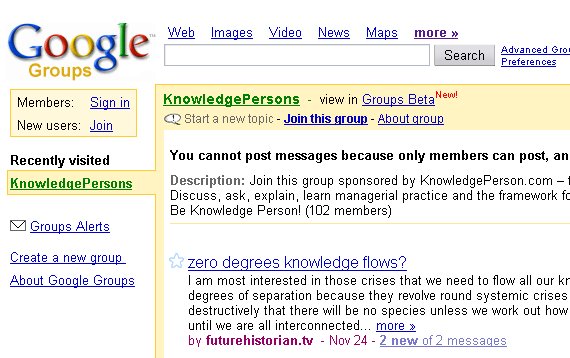
Bad example (from my experience) is Wikipedia governance (a transcript without formatting is below). It was discussed among Knowledge Persons.

But these models have the centralized parts (Skype, as far as I know, is a result of investing).

Can it be differently (I mean the completely dispersed model, where parts are changeable to sustain - netliving)? I don’t yet know. What can you say?

The transcript:

"[edit] Deleted content

You are talking about the links, but have deleted my definition of knowledge that was veryfied by the scientific community at knowledgeboard.com. Why and what's the reason?

Nikolay

In reply to:

Please do not add inappropriate external links to Wikipedia, as you did in Knowledge. Wikipedia is not a mere directory of links nor should it be used for advertising or promotion. Inappropriate links include (but are not limited to) links to personal web sites, links to web sites with which you are affiliated, and links that exist to attract visitors to a web site or promote a product. See the external links guideline and spam policies for further explanations of links that are considered appropriate. If you feel the link should be added to the article, then please discuss it on the article's talk page rather than re-adding it. See the welcome page to learn more about Wikipedia. Thank you. Veinor (talk to me) 16:36, 8 January 2007 (UTC)—The preceding unsigned comment was added by Nikolay Kryachkov (talk • contribs) 11:33, 8 January 2007 (UTC).

Ah. That was because:
The text was copyrighted material, which is not allowed on Wikipedia (unless there are fair-use rationales, which does not apply here).
The links were removed because they didn't contain any more information about knowledge itself, just about a project. I am not commenting on the site itself, merely whether it should be added to Knowledge. Veinor (talk to me) 17:46, 8 January 2007 (UTC)

I’m copyright holder and can’t republish my content on wikipedia? I would like to understand.

You said: "I am not commenting on the site itself, merely whether it should be added to Knowledge".

Who decides?

Nikolay

Any content put on Wikipedia automatically goes under GFDL. You'd have to prove that you're the author and that you're releasing copyright. Otherwise, the Wikimedia Foundation could get in large amounts of legal trouble due to copyright violations.
As for your second question, the community, generally. I'm not saying I have absolute power (I'm not even an admin, despite what some people think), but you need to prove that it should be added. I honestly can't see any way to do so; it doesn't provide any additional information on knowledge and it's not any sort of official site. Veinor (talk to me) 18:18, 8 January 2007 (UTC)

Veinor: "You'd have to prove that you're the author and that you're releasing copyright".

According to what? I think you must prove that I’m not author, if you state it (but why?). But you deleted the link to the content source (my website with my name as author/copyright holder) and content.

Veinor: "I honestly can't see any way to do so; it doesn't provide any additional information on knowledge ...".

Are you expert on 'knowledge' or censor? What the reason to prove to you?

Nikolay

The Wikipedia copyright policy is located at WP:COPYRIGHT. And you need to prove that you are the author per that policy. As for the appropriateness of the link, I think I misread what it is at first (the English is not very clear). I think that it's actually a method for getting organized (for arranging your information), is that correct? In any case, however, the link to knowledgeperson.com appears to fall under WP:SPAM (the sole purpose seems to be to sell things) and the blog and Google Groups link fall under WP:EL for being a blog and a forum, respectively. Veinor (talk to me) 22:15, 8 January 2007 (UTC)

Could you give me a quotation from your policy page that I need to prove that I’m the author? I did not find such an obligation/need.

If you suspect that I'm a thief, do prove that. If otherwise it's a blatant slander (1. a false and damaging statement about a person; 2. the crime of making such a statement).

I did not give the link to the product page. It was the link to the content source knowledgeperson.com/from_what.html

The links to my blog and google group were made because they have relevant detailed content.

Wikipedia, for example, has content about KPMG with the link to kpmg.com and what from that? Nikolay Kryachkov 06:52, 9 January 2007 (UTC)

I can't quote policy to prove that you need to be the author because it's copyright law and common sense. You can't give away other people's property without their possession; similarly, you can't release other people's copyrights. All I am saying is that you haven't given me proof that you are who you say you are. And you linked to both knowledgeperson.com/from_what.html and knowledgeperson.com (the latter in the External Links section). The reason KPMG links to kpmg.com is that it is the official site of KPMG. Even though it is probably not the best source for information on the company itself, WP:EL gives exceptions for official sites. Veinor (talk to me) 13:25, 9 January 2007 (UTC)

My question was about: "a quotation from your policy page that I need to prove that I’m the author", not about that I need to be the author (your: "I can't quote policy to prove that you need to be the author because it's copyright law and common sense").

Of course I need to be the author and I am the author.

You started from the statement that my links were inappropriate and then substituted the subject: "All I am saying is that you haven't given me proof that you are who you say you are".

If your job is to check author’s identity (in this case that I’m Nikolay Kryachkov and the author of my content), do it yourself, but don’t waste my time. Proving my identity is not my obligation (you did not give me any legal reason for that).

KnowledgePerson.com is my official project.

And now give me your real name, your employer contact data. I’ll think about the legal steps. Nikolay Kryachkov 18:20, 9 January 2007 (UTC)

You need to prove that you're the author because, if your claims are taken as true, you aren't the author, and the REAL author recognizes the copyright violation, the Wikimedia Foundation could get in a large amount of trouble for hosting copyright violation. And it isn't my job to prove that you're the author; I have no way of doing so. And it isn't your obligation either unless you want the removed content on Wikipedia. Finally, do not make legal threats on Wikipedia. And I will not give you my contact information for privacy reasons. Veinor (talk to me) 22:45, 9 January 2007 (UTC)

1. Your: "it isn't my job to prove that you're the author". No, YOU must prove that I’m NOT the author, if you state this. There is a presumption of innocence and YOU violate this presumption. It’s the fact. And keep your hypothetical trouble with you.

2. I did not ask YOUR contact information. I asked your employer contact information.

3. It’s impossible to make LEGAL threat. I said: "I’ll think about the legal steps".

4. According to this from your private message to me: "Your recent edits could give other users the impression that you may consider legal or other 'off-wiki' action against them" I can say – don’t connect YOUR doings with users.

5. I know you can block my account as you have said me privately. It is really threat (a declaration of an intention to inflict harm).

6. You're making Wikipedia reputation with your "customer service".Nikolay Kryachkov 17:09, 10 January 2007 (UTC)

1. Ok, how about you prove that I'm not the author so that anyone else can verify that proof? And why are you so averse to proving you are who you say you are? I'm not familiar with the procedure myself, but I don't imagine it would be that complicated.

2. If you knew my name and employer contact data, you would be able to find me.

3. Well, I thought you meant that you'd think about the legal steps you'd take against me. What did you mean, then?

4. What the statement means is that your statement could lead people to believe that you're considering taking action against me outside of Wikipedia.

5. I can't block my account; I can only request for an admin to look at the situation. I am not an admin. Note the difference between "you will be blocked" and "I will block you".

6. How so? I doubt people will judge Wikipedia based on me alone. Veinor (talk to me) 17:19, 10 January 2007 (UTC)

1. As I have said there is presumption of innocence and I have rights.

2. I noticed you’re in subjunctive mood.

3. Legal steps.

4. You probably have nothing to do.

5. No difference because of a chain of actions.

6. That means you have violated my right.Nikolay Kryachkov 19:16, 10 January 2007 (UTC)

Huh? Which one of those is a reply to which? Veinor (talk to me) 22:11, 10 January 2007 (UTC)"

Tuesday, January 09, 2007

Swicki

Never thought that search can be customized by a group. Swicki, for instance, gives an opportunity for that.

I think it’s useful for the networked projects when people rearrange the web representation in order to see what is relevant to their project.

Imagine you are a co-creator of the networked product and:

- your website about your doings is on the top of swicki search results among your fellows co-creators;
- customers, competitors and any person can add her/his criticism to your group business activity by suggesting another search results;
- etc.

I put swicki search box at the sidebar of this blog and you can suggest what is relevant to the "Knowledge Person" and other concepts I mentioned. Additionally you can add this search box to your website (alongside of your own) and let your readers to criticize the mentioned concepts (it would be useful). The code is here.

Saturday, January 06, 2007

The labels of knowledge

There is a feature for new version of blogger – "labels" – please see my sidebar. It can be used to tag/sort/categorize/structure an appropriate content in order to find it and use.

You can see I use the questions from KnowledgePerson.com.

How I do that?

I read my content and if see some text that can be the answer to the question I label it. These eight labels/tags/categories are universal, I think. They are suitable for any content and therefore might be used to solve this problem of tagging and social search – authors’ and readers’ tags are usually different and "search" doesn’t equal "find" (though it (search) is good business).

Of course this method isn’t yet precise and is subjective. It hasn’t yet the rules, but after labeling I realized that I posted lesser content about "instruments" (By what), though I didn’t yet go with labeling inside User and Consultant directories.

If knowledge equals understanding and consist of these labels, passed and searched knowledge can be found and considered, shared, learned, transferred, applied, used, developed further ...

Try to experiment with your content and these labels of knowledge and tell me what your findings are.

Thursday, December 28, 2006

2007

I wanted wishing Knowledge Persons prosperous 2007 in a few words, but wrote more ...

Prosperous 2007 to the World!

Tuesday, December 19, 2006

The framework, version 1.4

The framework for collaborative self-consulting has new version 1.4. It’s because my bank changed its name – now VTB 24 (JSC). Other content remains the same.

Tuesday, December 12, 2006

Text viruses

This is an introduction to text viruses - the human made infection that leads to mismanagement.

Who

The concept of text viruses was created by me during the consulting works in the mid of 1990th and its first public representation was started in 2000 – a few articles in Russian printed scientific journals and on the web.

What

Text viruses are the meanings of wording of action, which lead people to different understanding of action and to its different implementations.

From what

A source of differences in understanding of actions is the meanings (more than one) that many words of our language have.

Wording of action is not yet precisely defined and is being elaborated.

When we think, read, write, speak, move, even sleep, etc. - we act. But why all this is represented in sentences when we use language, not in wording of actions?

This misbalance between natural actions and their representations in human language hides our possible knowledge of what our messages, texts, commands, instructions, requests, etc. can do, what networks is being constructed when we pass all this to other people.

Answering these questions: who(?); what(?); from what(?); why(?); how(?); where(?); when(?); by what(?); and how much(?) is the first step to represent and consider wording of action and to know the variants of possible actions. Name it discovering and constructing the future.

Why

Any goods and services have two parts – information part (descriptions, manuals, advertisements, etc.) and physical part (goods and services themselves). Information part is the very "thing" in which people come into contact with first of all. After that people decide to buy or not, to use or not, etc.

Your goods and services can be perfect, but if their information part is not understood as you need (has variants of understanding) people may go to your competitors. It means that so-called networks are not only about who connect whom as a static picture. Any human message (information part of something) in any time creates the set of human connections according to the meanings of the message (networks or managerial structures) and who knows which of them is active in this time.

How

I can suggest you two ways to eliminate text virus impact.

One is to find problematic content that causes an improper curve of your competitiveness (the money results of your organization do not grow, but its outflow grows) and normalize it by usual means (many specialists and consultants can assist you). There is no need to restructure every document you use in wordings of actions.

If this does not help, you should restructure the problematic content you found in wording of actions to see the variants of understanding and reduce their quantity. It is another and direct way.

By what

A need of common understanding may require maintaining a public vocabulary for your organization in order to avoid misunderstanding and unexpected actions. George Orwell wrote in his novel "1984": "Who controls the vocabulary, controls the knowledge".

There is no need to fear ONE understanding. It is only a prerequisite for free people to decide whether to use it or not. It is about managing knowledge, if you agree that knowledge equals understanding. And since you can see in wording of actions the variants and some of them are not yet used – you can innovate by experimenting with new understandings of actions. Let’s call it "text experiment" that can be not expensive.

Where

Modern organizations become more globally dispersed and if you use social software, vocabularies and specify content by maintaining dialogues, you can prevent text virus impact everywhere

When

and every time.

How much

If some estimation of 66% information losses during written communication is correct, you probably waste 66% of investments in documenting the activity (manuals, advertisements, law, etc.) and probably get 34% of result when you influence others with the use of texts. Yes, it is the average values and can be different in the particular situation.

Think about non statistical data – only two variants of understanding of wording of action result in:

- 50% risk of misunderstanding;
- as minimum two networks or managerial structures (one - according to the first meaning and the second one - according to the second meaning) and one of them can be hidden;
- effect as if people demonstrate a lack of skills, but in fact they may have different understanding.

***

Culture is not mystic. Every human action is being done within vocabulary. Invisible human made language structures - text viruses can be visible and their impact can be limited because only we humans are responsible for our language and actions.

An old link: Openly Cross-Examining what a text virus is, and why it can cause costly knowledge damage.

Wednesday, December 06, 2006

Knowledge Persons are individuals in collaboration

Here is what I would like to underline after discussing the ways to connect different networks. I was said that mixing up the networks isn’t a good idea, but do consider this:

If you have knowledge and agree that knowledge equals understanding that is needed before taking actions for better future and you don’t limit others in it, you may name yourself Knowledge Person.

Group for Knowledge Persons is individually oriented and therefore every Knowledge Person has only own nerve center (no "wisdom of crowds", rule of majority, etc.). Every decision is individual, but can be discussed, checked and corrected in collaboration with others.

This group is project oriented and you are free and welcomed to introduce yourself, your project/business in order to find healthy criticism, support and partnership. If you represent your own network you can promote it among Knowledge Persons. This can be an additional way towards your network. Why not?

Sunday, November 26, 2006

100 Knowledge Persons


Some philosophers think that quantity can result in quality.

Read, join and maybe co-create Knowledge Era Games locally and globally.

Sunday, November 19, 2006

When to meet?

I don’t know what is better - to choose the directions of development on-line and then meet Knowledge Persons, for example, in St. Petersburg or meet and talk to them in order to choose the directions?

I need your advice.

In St. Petersburg after my business day:


Friday, November 17, 2006

Knowledge Management at the crossroads

Recently I initiated a discussion at Value Networks that might outline a direction of not far future (educational, social, business). It was about a connection of:

- content structuring for managerial purposes;
- Knowledge Money (or network bank) and
- new licensing model (applied to any digital content and positioned between OpenSource, GNU GPL, CreativeCommons and closed patented content).

Unfortunately only one person participated - Richard Vines from Australia.

15.11.06 Dr Janet Hope (from Australia) asked OpenSource community about applying OpensSource principles to biological researches/industry.

Before that I read that Andrey Filippov applied GNU GPL to his hardware. And maybe there are other examples.

So what we have - the emerging need to connect open development flow with social, business and financial infrastructure?

What we lack to be ready for that?

Shall we go this direction?

Sunday, November 12, 2006

To be or not to be self-programmed?

As far as I know there are two edges in management.

One is predefined rules (programs) according to which people should act. This works if people understand such rules in the same way and if these rules are possible to observe (people usually don’t read long rules, if it isn't their job).

Another one is a creation of behavior patterns. People can be encouraged to form some habits (programs) and after that even a weak signal from outside can start the habit. To do this, people must be classified to use them when the specific work will be needed for the system.

From the personal perspective truth can be somewhere in between. You can use these questions and check the rules and the habits. It doesn’t require data bases and even computer – just find the answers and correct your actions.

This light (not bulky) structuring allows you to be self-programmed and filter the signals from outside.

Sunday, November 05, 2006

Writing/Editing - Art or Business Service?

I took this title from the Knowledge Persons' group post by Wytze Rijpkema. And it interconnects with PR, copywriting, corporate blogging, marketing and sales.

The problems are:

- to blog or not to blog goods and services from corporation?
- what to do with comments?
- how corporate blogging can influence sales?
- can corporate blogging be outsourced?

What are the solutions?

It's not only a question to corporate executives. Since the web is two-way communication and many skilled self-employed persons can add real values to business, it's time for suggestions from everyone.

Please spread this post and assist self-employed persons and business to connect. And maybe you will find self-employment suitable for your life with family, kids and friends.

Tuesday, October 31, 2006

A source of competitiveness

If you will decide to use the framework for collaborative self-consulting, persons in your organization can:

- connect the documents they create and use with the cash-flow and see how their content (as the source of actions) influences the changes of the competitiveness (represented graphically);
- correct the activity of the organization in time and even experiment with planned values to choose the direction of the development;
- use social software to collaborate inside and outside the organization more productively and understand what they really did, do and will do for the organization;
- save money when identify the problems because it can be a part and responsibility of daily work in the organization (by writing, correcting and using the content);
- innovate, verify innovations and implement them, because they are responsible for the open organization and the organization is responsible for them;
- learn, work and live peacefully, because competitiveness and future are their competence.

Consider all this.

Friday, October 27, 2006

Knowledge Money will be yours

Knowledge Society, Knowledge Economy, Knowledge Management and now Knowledge Person ...

Where are real stuff for ordinary people here, even for nearest future?

Let’s think about Knowledge Money, which every Knowledge Person will probably emit.

Here is my "Nonprofessional forecast" and reader’s comment, republished from my Russian blog:

"Nonprofessional forecast

10.04.06.

Let me recollect John (Beau) Law from Scotland, who pioneered modern banking in France of 18th century, because I think something significant may occur over time with money and global economy:

1. Information part of goods and services or intangibles, or knowledge become more and more costly in modern economy – see "Foresight 2020: Economic, industry and corporate trends".

2. Entrepreneurship shifts to authorship.

3. States may lose their monopoly on regulation of authorship – licensing, because the Web hasn’t state borders.

4. In tangible world when you sell goods you lose them and get money in exchange. In intangible world when you sell knowledge you don’t lose it and get money again and again for the same.

5. Because of nature of knowledge (can be multiplied for low cost) its authors (not states) may become a source of liquidity and states may lose their monopoly on money emission.

6. Money, which will serve intangibles, may absorb money, which serves tangibles, because intangibles may grow faster than tangibles.

7. Networking or maybe netliving creates a third temporary value – connection: 1 person + 1 person = 2 persons (dead network) or 2 persons and 1 connection (1+1=3 - living network - netliving). Any network lives only if the connections take place. Connection is impossible without content – information part of goods and services or knowledge, or intangibles.

In nearest future entrepreneurs or authors must create markets: intangibles, tangibles, netliving, perhaps licensing and money.

The question is who works on this, if my nonprofessional forecast makes sense?

Re: Nonprofessional forecast

11.04.06.

Nikolai,

As usual, I like the way you think and I enjoy this type of dialogue.

You are describing several aspects of a major social transformation that is now well underway. We currently live in a world in which three economies are churning at the same time and we are swiftly moving toward a fourth.

a) We are experiencing the last stages of the Industrial Economy
b) We have also seen a twenty year transition called the Creative Knowledge Economy.
c) We are resently in the early stages of a Web/Networked Economy
d) And out on the horizon we can see a molecular economy taking shape with the rise of nanotechnology.

This shifting economy is just one of several emerging megatrends. These relate to things like the environment, some to the rate of change and technological advance, an aging population, etc. See this link for a list of the key trends:

http://www.2enlightenment.com/megatrends.htm

Theses trends are causing us to rethink the very core of how we operate as a society. You are exactly right to ask the question, "who works on this?" because these issues are not going to fix themselves and will require attention from intelligent people.

The Second Enlightenment Conference is a seedbed to step up to these types of issues and work on them vs. waiting for them to overwhelm our world.

The conference is organized against a set of principles that show how we need to progress in various areas.

http://www.2enlightenment.com/principles.htm

These lists are living documents and the conference will be a dialogue that centeres in on this starting point.

In short this effort is designed to bring a broad group of individuals into the realm of transformation.

Reformation is simply changing the present course to adjust to changes as they occur in the current context.

Transformation is a complete contextual, behavioral, attitudinal, and capacity rework within a futures context.

Simply reforming our world won't be enough…we need to transform the way we think, know, behave, govern ourselves, etc.

Take a look at this presentation:

http://www.2enlightenment.com/Presentation/SECv2.swf

In particular, notice the three "Cultural Creatives" slides near the end of this presentation. I belive that this group of socially conscious individuals is rising up to work on these kinds of social needs. Without such an effort, even just one of these megatrends could represent a major downfall in human achievement.

If you are interested in getting invovled with this type of transformation, contact Rick Smyre at rlsmyre at aol.com."

Monday, October 23, 2006

When sloping downwards

Sometimes a situation of sloping downwards occurs. Your competitiveness may look like this:


Usually the problem is to identify the reasons to correct them. With the use of the framework for collaborative self-consulting (version 1.3, section 8) you can identify a cell with improper numbers and then identify improper content and its authors, which led to this situation.

This work you can do independently and that’s why the framework is for self-consulting.

Content correction may require specific knowledge. It’s good if you will manage it independently again. If not, search and ask consultants for that. That’s why the framework is for collaborative self-consulting.

Text Link Ads